

TKC: Takayama evergreen coniferous forest site
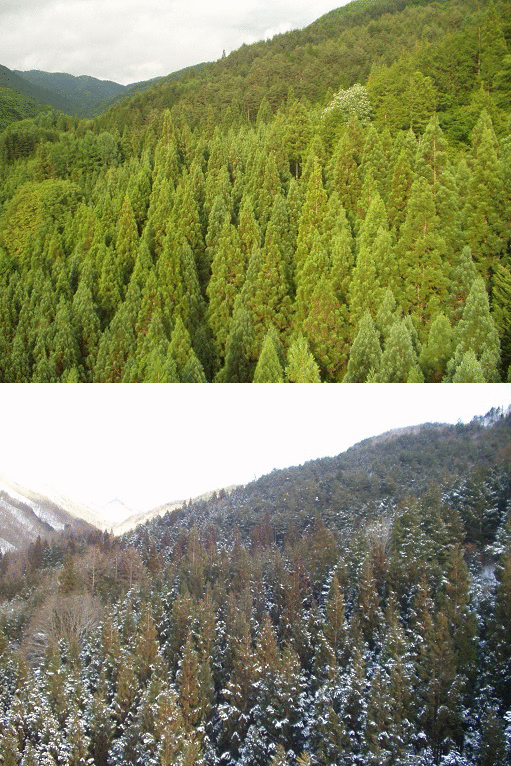
General site details
| Site name | Takayama evergreen coniferous forest site |
|---|---|
| AsiaFlux site code | TKC |
| Location | Takayama, Gifu, Japan |
| Position | 36º 08' 23" N, 137º 22' 15" E (World Geodetic System 1984, GPS) |
| Elevation | 800m above sea level (World Geodetic System 1984, GPS) |
| Slope | 20.8 deg |
| Terrain type | Mountainous area |
| Area | 150 ha (Continuous forest area), 0.15 ha (Ecological experimental area) |
| Fetch | 200-1500 m |
| Climate | Cool temperate (Snow - fully humid - warm summer (Dfb)) |
| Mean annual air temperature | 10.7 degreeC (1967-2006 at Takayama weather station; 36º 09' 18" N, 137º 15' 12" E, 560.1 m above sea level) |
| Mean annual precipitation | 1722 mm (1967-2006 at Takayama weather station; 36º 09' 18" N, 137º 15' 12" E, 560.1 m above sea level) |
| Vegetation type | Planted Evergreen Coniferous Forest |
| Dominant Species (Overstory) | Cyptomeria japonica, Chamaecyparis obtusa |
| Dominant Species (Understory) | shurabs (Acanthopanax sciadophylloides, Reynoutria japonica), herbs (Houttuynia cordata, Chrysosplenium japonicum), ferns (Dryopteris crassirhizoma, Archniodes standishii) |
| Canopy height | about 20 m |
| Age | 40-50 years (in 2011) |
| LAI | PAI (Plant Area Index) 4.9-5.2 m2 m-2 |
| Soil type | Volcanogenous regosol |
Observation
Eddy Covariance method (CO2)
| System | Open-path systems (CO2 flux, latent heat flux) |
|---|---|
| Wind speed | Three-dimensional sonic anemometer-thermometer (R3-50, Gill Instruments, UK) |
| Air temperature | Three-dimensional sonic anemometer-thermometer (R3-50, Gill Instruments, UK) |
| Water vapor | Open- and Closed-path CO2/H2O analyzers (LI-7500, LI-COR), |
| CO2 | Open Path CO2/H2O Gas Analyzer (LI-7500, LI-COR, USA) |
| Measurement height | 31 m |
| Sampling frequency | 10 Hz |
| Averaging time | 30 min |
| Data logger | PC |
| Data storage | HD |
| Original data | Raw data |
Meteorology
| Observation items | Levels/Depth | Instrument |
|---|---|---|
| Global solar | 30.5 m | CM6B (Kipp & Zonen) |
| Global solar radiation (outgoing) | 29.7 m | CM6B (Kipp & Zonen) |
| Long-wave radiation(incoming) | 30.5 m | CG3 (Kipp & Zonen) |
| Long-wave radiation(outgoing) | 29.7 m | CG3 (Kipp & Zonen) |
| PPFD (incoming) | 30.5 m | LI-190SZ, LI-COR, USA |
| PPFD (outgoing) | 29.7 m | LI-190SZ, LI-COR, USA |
| PPFD (Forest floor) | six points | LI-190SB (LI-COR, USA), IKS-27 (Koito, Japan), IKS-25 (Koito, Japan) |
| Air temperature | 30.2, 22.8, 18.4, 14.7, 10.6, 6.5, 3.6, 1.3 m | Platinum resistance thermometer with ventilated radiation shields (HMP45A, VAISALA, Finland) |
| Humidity | 30.2, 22.8, 18.4, 14.7, 10.6, 6.5, 3.6, 1.3 m | Capacitive hygrometer with ventilated radiation shields (HMP45A, VAISALA, Finland) |
| Surface temperature | 30, 22, 2 m | Infrared Thermometer (MI-710, PTEX, Siga, Japan) |
| Soil temperature | 0.05, 0.1, 0.15, 0.2, 0.4 m | Thermistor (107, Campbell, USA) |
| Soil water content | 0.05, 0.1, 0.15, 0.2, 0.4 m | TDR sensor (CS616, Campbell) |
| Wind speed | 31, 23.4, 6.5, 2 m | 3-cups anemometer (A100L2, Vector, UK), Sonic anemometer (Windsonic, Gill instruments, UK) |
| Wind direction | 30.9, 6.5, 2 m | Wind vane (W200P, Vector, UK), Sonic anemometer (Windsonic, Gill instruments, UK) |
| Barometric pressure | 1.5 m | Barometer (PTB210, Vaisala) |
| Precipitation | 30.9 m | Tipping-bucket rainguage with heater (CYG- 52202, R. M. Young) |
| Snow depth | 3.32 m | Ultrasonic distance sensor (SR-50, Campbell, USA) |
| CO2 concentration | 30.2, 22.8, 18.4, 14.7, 10.6, 6.5, 3.6, 1.3 m | CO2 gas analyzer (LI-820, LICOR, USA) |
Other
| Soil respiration | Continues (automated chambers) by CO2 gas analyzer (LI-820, LI-COR, USA) |
| Photosynthesis | - |
| Ecological investigation | Tree heights (2005), Crown projection (2005), Diameter of Breast Height, Biomass (2004 to present; every year), Litter fall (about every two months) |
| Water cycle within canopy | Through fall (twenty four points), Stem flow (three points) |
| Remote sensing | Fish-eye photographs (canopy, sky) and Radiative spectrum (income, outcome) by PEN (Phenological Eyes Network) system. Fish-eye photographs at ninety six points on the forest floor (November 7, 2006) |
Observation Period and Data Availability
| Measurement Period | January 2005 to present |
|---|---|
| Measurement Frequency | Continuous |
| Data Availability | 2007 in AsiaFlux Database |
Contact
Ichiro TAMAGAWA (tama [at] green.gifu-u.ac.jp) [Flux and micrometeorology] Taku M. SAITOH (taku [at] green.gifu-u.ac.jp) [Soil respiration and ecological survey] Yuichiro YASHIRO (yashiro [at] green.gifu-u.ac.jp) [Water cycle within canopy] Toshiharu KOJIMA (kojima [at] green.gifu-u.ac.jp) River Basin Research Center, Gifu University1-1 Yanagido, Gifu, 501-1193 Japan
[Remote sensing] Shin NAGAI (nagai [at] green.gifu-u.ac.jp) Research Institute for Global Change, Japan Agency for Marine-Earth Science and Technology3173-25 Showa-machi Kanazawa, Yokohama, 236-0001 Japan
Infrastructure
Tower, Electrical power (AC), Facilities for communication (LAN to Gifu University), Accommodation (Takayama research site, Gifu University; About 20 minutes by car from TKC site).
Research Fund
JSPS 21st Century COE program "Satellite Ecology" at Gifu University (FY2004-2008)
Grant-in-Aid for Young Scientists (B) (#18780113) from the Ministry of Education, Culture, Sports, Science and Technology of Japan to Dr. TM Saitoh (FY2006-2007)
Grant-in-Aid for Scientific Research (A) (#21241009) from the Ministry of Education, Culture, Sports, Science and Technology of Japan to Dr. H. Kondo (FY2009- 2011)
Calibration Information
Open-path analyzers were calibrated approximately every two-six months with two standard CO2 gases of 0 ppmv and 500 ppmv. The gain of CO2 of the closed-path analyzers (Li-820, LI-COR, USA) was checked one a day by flowing two standard CO2 gases of 0 ppmv and 500 ppmv, that were automatically controlled using CR10X (Campbell, USA).
Publication
Lee M.-S., Lee J.-S., Koizumi H. (2008) Temporal variation in CO2 efflux from soil and snow surfaces in a Japanese cedar (Cryptomeria japonica) plantation, central Japan. Ecol Res 23:777-785.
Lee N.-Y., Koizumi H. (2009) Estimation of the number of sampling points required for the determination of soil CO2 efflux in two types of plantation in a temperate region. J Ecol Field Biol 32:67-73
Senda M., Kageyama K., Suga H. and L?vesque A. (2009) Two new species of Pythium, P. senticosum and P. takayamanum, isolated from cool-temperate forest soil in Japan. Mycologia 101:439-448.
Yashiro Y., Lee N.-Y., Ohtsuka T., Shizu Y., Saitoh T.M., Koizumi H. (2010) Biometric based estimation of net ecosystem production (NEP) in a mature Japanese cedar (Cryptomeria japonica) plantation beneath a flux tower. Journal of Plant Research., 123, 463-472, DOI 10.1007/s10265-010-0323-8.
Saitoh T.M., Tamagawa I., Muraoka H., Lee N-Y., Yashiro Y., and Koizumi H. (2010) Carbon dioxide exchange in a cool-temperate evergreen coniferous forest over complex topography in Japan during two years with contrasting climates. Journal of Plant Research. , 123, 473-483, DOI 10.1007/s10265-009-0308-7.
Saitoh T.M., Tamagawa I., Muraoka H., and Koizumi H. (2010) Heat storage due to photosynthesis and respiration activities in forests, Journal of Agricultural Meteorology, 66(4), 289-298 (in Japanese with English summary).
Sasai T., Saigusa N., Nasahara K.M., Ito A., Hashimoto H., Nemani R., Hirata H., Ichii K., Takagi T., Saitoh T.M., Ohta T., Murakami K., Oikawa T., Yamagichi Y. (2011) Satellite-driven estimation of terrestrial carbon flux over Far East Asia with 1-km grid resolution, Remote Sensing of Environment 115, 1758-1771, doi:10.1016/j.rse.2011.03.007.
Saitoh T.M., Tamagawa, I. and Muraoka H. (2011) Effect of storage CO2 term on evaluating carbon budget using eddy-covariance measurement,Journal of the Japanese Forest Society, 93,105-112 (in Japanese withEnglish summary).
Saitoh T.M., Tamagawa, I., Muraoka H., and Koizumi H. (2011) Energybalance closure over a cool temperate forest in steeply slopingtopography during snowfall and snow-free periods, Journal of Agricultural Meteorology, 67(3), 107-116
Nagai S., Saitoh T.M., Kobayashi H., Ishihara M., Suzuki R., Motohka T.,Nasahara K.N. and Muraoka H. (in press) In situ examination of the relationship between various vegetation indices and canopy phenology in an evergreen coniferous forest, Japan. International Journal of Remote Sensing.
Saitoh T.M., Nagai S., Yoshino J., Muraoka H., Saigusa N., and TamagawaI. (accepted) Functional consequences of differences in canopy phenologyfor the carbon budgets of two cool-temperate forest types: simulationsusing the NCAR/LSM model and validation using tower flux and biometricdata. Eurasian Journal of Forest Research.