

TSE: Teshio CC-LaG experiment site
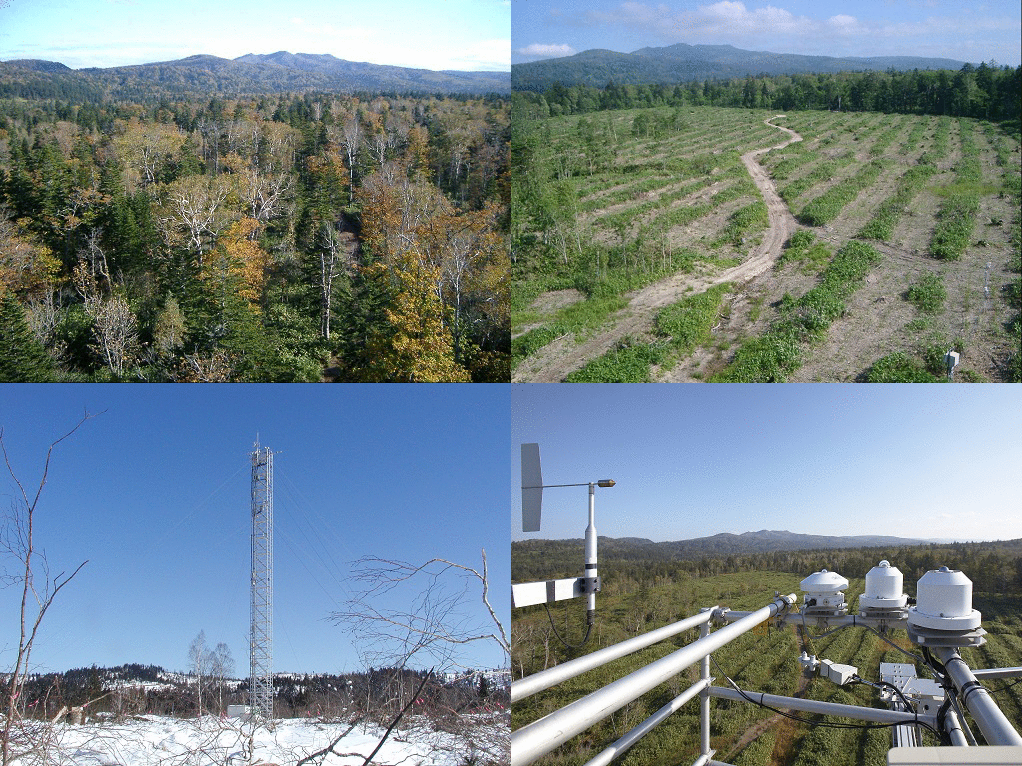
General site details
| Site name | Teshio CC-LaG experiment site |
|---|---|
| AsiaFlux site code | TSE |
| Location | Teshio Experimental Forest, Toikanbetsu, Horonobe, Hokkaido, Japan |
| Position | 45°03' 21"N, 142° 06' 26"E |
| Elevation | Elevation: ca.70m, a.s.l. |
| Slope | < 8 deg |
| Terrain type | Flat Terrace |
| Area | 13.7 ha (Clear-cutting area), however, same vegetation type extends ca. >1 km for each direction before clear-cutting |
| Fetch | >1 km (mixed forest), 200-500 m (after clear-cutting) |
| Climate | Cool temperate |
| Mean annual air temperature | 5.7 degC |
| Mean annual precipitation | 1000 mm |
| Vegetation type | Conifer-Hardwood mixed forest until January, 2003, Young larch plantation from late October 2003 (ca. 30000 saplings (ca. 2500 saplings ha-1; 0.04 tC ha-1)) |
| Dominant Species (Overstory) | Quercus crispula, Betula ermanii, Betula platyphylla var. japonica, Abies sachalinensis, Picea jezoensis (mixed forest), hybrid (Larix gmelinii × L. kaempferi) larch (young larch plantation) |
| Dominant Species (Understory) | Sasa senanensis and Sasa kurilensis |
| Canopy height | 18-25 m (mixed forest), 1-2.5 m (larch plantation in 2006) |
| Age | Large trees in the clear-cutting area were more than 200-years old(Tsuji et al., 2006). In Autumn 2003, 2 year-old larch saplings were planted. |
| LAI | 3 and 4-4.5 in a full-growing period for canopy and Sasa layer, respectively in the mixed forest, Larch LAI in the stripe-cut row is ca. max 1.3 in 2005 and Sasa in the remained row is increasing (ca. max 5.7 in 2005) after the clear-cutting (measured by LAI-2000, LI-COR) |
| Soil type | The bedrock was Cretaceous sedimentary rock. The dominant soil was a Gleyic Cambisol (FAO 1988) with about 10 cm of O horizon, with a mor humus type, 20 cm of A horizon, and 30 cm of B horizon |
Observation
Eddy Covariance method (CO2)
| System | Open-(periodic & continuous from Apr. 2006) & Closed-path systems (CO2 flux, latent heat flux) |
|---|---|
| Wind speed | Sonic anemometer-thermometer (KAIJO, DA600-3TV, TR- 61C), Sensor span: 20 cm, Height at 32 m, ca. 10 m above canopy surface. After the clear-cut (from June 2003), another sonic anemometer-thermometer (KAIJO, DA600- 3TV, TR-61A) has been set near the ground |
| Air temperature | same as air wind speed |
| Water vapor | Before clear cut: [Open-path method (periodic)] NDIR-gas analyzer (Data Design Group , OP-2), Sensor span: 20 cm, Separation distance: 20 cm, Height at 32 m, ca. 10 m above canopy surface, [Closed-path method] NDIR-gas analyzer(LI-COR, LI- 7000), Distance between gas inlet and NDIR: 6m, Height of gas inlet: 32 m, ca. 10 m above canopy surface, Distance between gas inlet and anemometer: 15 cm. After clear cut: [Open-path method (periodic)] NDIR-gas analyzer (Data Design Group , OP-2), Sensor span: 20 cm, Separation distance: 30 cm, Height at 4.6 m, ca. 4 m above canopy surface (from June to Septerber 2003), NDIR-gas analyzer (LI-7500 , LICOR),Sensor span: 12.5 cm, Separation distance: 20 cm, Height at 4.6 m, ca. 3 m (in 2006) above canopy surface (from April 2006) [Closed-path method] Two NDIR-gas analyzers(LI-COR, LI- 7000), Distance between gas inlet and NDIR: 6 & 15 m, Height of gas inlet: 32 & 4.6 m, ca. 30 & 3 (in 2005) m above canopy surface, Distance between gas inlet and anemometer: 15 & 5 cm. Flux measurement at 32m height was until April 2007 |
| CO2 | same as water vapor |
| Measurement height | see above |
| Sampling frequency | 10 Hz |
| Averaging time | 30 min |
| Data logger | DRM3 (TEAC Corp) (until Oct 2003), CR5000 (CSI) (from Nov 2003) |
| Data storage | MO&HD(until Oct 2003), HD card&HD (from Nov 2003) |
| Original data | All the raw data are recorded and saved |
Meteorology
| Observation items | Levels/Depth | Instrument |
|---|---|---|
| Global radiation (downward) | 32 m | Thermopile type pyranometer (Kipp & Zonen, CM-21F) |
| Shortwave radiation (downward) | 32, 3 m | Net radiometer (Kipp & Zonen, CNR-1) |
| Shortwave radiation (upward) | 32, 3 m | Net radiometer (Kipp & Zonen, CNR-1) |
| Long-wave radiation(downward) | 32, 3 m | Thermopile type infrared radiometer (EPPLEY, PIR only at 32m), Net radiometer (Kipp & Zonen, CNR-1) |
| Long-wave radiation(upward) | 32, 3 m | Net radiometer (Kipp & Zonen, CNR-1) |
| Net radiation | 32, 3 m | Net radiometer (Kipp & Zonen, CNR-1) |
| PPFD (incoming) | 32, 3 m | Quantum sensor (EKO, ML-020P, Japan; From May 2007) |
| PPFD (outgoing) | 32, 3 m | Quantum sensor (EKO, ML-020P, Japan; From May 2007) |
| Air temperature | 32, 21, 10, 4, 2 m | Ventilated platinum resistance thermometer (VAISALA, HMP45D; From April 2008) |
| Humidity | 32, 21, 10, 4, 2 m | Ventilated platinum resistance thermometer (VAISALA, HMP45D; From April 2008) |
| Soil temperature | -1, -5, -10, -20, -40, -80, -120 cm (×1 profile), -1, -5, -10 cm (×4 profiles) | Platinum resistance thermometer (CLIMATEC, C-PTWP) |
| Soil heat flux | -2 cm×5 points | Heat flow transducer (REBS, HFT-1.1) |
| Soil moisture | -5, -10, -30, -60 cm (×1 profile), -5, -10 cm (×4 profiles) | Water content reflectometer (CSI, CS615) |
| Wind speed | 32, 21, 10, 4 m | Photo-electric cup anemometer (MetOne, 010C; 32m) Ultrasonic wind sensor (Gill, WindSonic; 21, 10, 4m; From April 2008) |
| Wind direction | 32 m | Photo-electric wind vane (MetOne, 020C) |
| Atmospheric pressure | 2 m | BAROCAP barometer (VAISALA, PTB210-C6C5A) |
| Precipitation | 3 m | 0.1 mm-pulse tipping-bucket rain gauge with heater (RM Young, CYG-52202) |
| Snow depth | Setting height: ca. 4m | Sonic ranging sensor (CSI, SR50) |
Other
| Soil respiration | Automated closed chamber (Liang et. al., 2003, Agricultural and forest meteorology, 123, 97-117) (June 2003-), 8 points for larch saplings (2004-2005), 8 points for Sasa (June 2004-) and 8 points for soil; Sampling interval: every 1 hour in snow free peri |
| Photosynthesis | Sasa & Larch data in the above chamber measurement can be available for NEP estimation. |
| Ecological investigation | LAI: Canopy and Sasa layers (LI-COR, LAI-2000),Sampling interval : ca. every 2 weeks (May, 2001 - Decemver, 2002, before the clear cut), Larch saplings and remained Sasa rows (LI-COR, LAI-2000), Sampling interval : ca. every 2 weeks to 1 month (from May, 2003 -, after the clear cut) Biomass: 1. Tree DBH (and its inter-annual change(2000-2002)), species, crown size measurement in a 50×50 m quadrat beside the tower (2000), (Koike et. al., 2001 , Eurasian Journal of Forest Research, 2, 65-79), 2. Soil survey (2000, 2002), 3. 14ha experiment site wood biomass survey (2000) (Koike et. al., 2001, Eurasian Journal of Forest Research, 2, 65-79), 4. Biomass research of Sasa species (above and below the ground surface in 2001), 5. Biomass researches for dominant species (from 2001, 1 species for 1 year), 6. Airborne LIDAR measurement (2002, 2004), 7. Larch growth observation (every year), 8. Fine root biomass & the turn over rate (Fukuzawa et. al., 2006, Forest Ecology and Management, 225, 257-261; Fukuzawa et .al., 2006, Ecological Research, doi: 10.1007/s11284-006-0031-y) |
| CH4 | Soil Chamber (2013-) |
Other Information
| 250 m south from power generators (until February 2005) and 200 m west from unpaved road. There was a selection cutting in 1961 (15% of trees) in this experimental area. Some trees around the tower had been cut in advance, to prevent causing damage to the tower when trees were clear-cut. During January to March 2003, trees in the area of 13.7 ha were clear-cut. Preliminary research revealed that the total biomass volume of trees in this area was 2193 m3 (Koike et. al., 2001, Eurasian Journal of Forest Research, 2, 65-79) and this cutting removed the woods of 1203 m3 (ca. 19 tC ha-1) from this ecosystem. Sasa bamboos (the above ground biomass is 6-12 tC ha?1) under the snowpack had been kept intact during the clear-cutting period in winter, however in order to plant larch saplings, those were strip-cut into 4 m rows (a half of the clear cut area) seven month after the clear- cutting and just before the plantation (late October 2003). ca. 30000 saplings (ca. 0.04 tC ha-1) of 2-year old hybrid larch were planted in October 2003. |
Observation Period and Data Availability
| Measurement Period | From 2001 |
|---|---|
| Measurement Frequency | Continuous |
| Data Availability | 2001-2002, 2004-2012 in AsiaFlux Database |
Contact
Kentaro Takagi (kentt [at] fsc.hokudai.ac.jp)
Teshio Experimental Forest, Field Science Center for Northern BiosphereHokkaido UniversityToikanbetsu, Horonobe, Hokkaido
098-2943, Japan
Tel: +81-1632-6-5211 Fax: +81-1632-6-5003
Nobuko Saigusa (n.saigusa [at] nies.go.jp)
Center for Global Environmental Research (CGER),National Institute for Environmental Studies (NIES)
16-2 Onogawa, Tsukuba, Ibaraki 305-8506, Japan
Tel : +81-29-850-2976, 2517 Fax : +81-29-858-2645
http://db.cger.nies.go.jp/gem/moni-e/warm/flux/teshio.html
Infrastructure
Tower: 32 m(Climbable)& 5m
Electrical power: By commercial power line from February 2005. AC100&200V are available.
Facilities for communication: Mobile phone is available at the tower top.
Accommodation: A portable house of ca. 10 m2
Research Fund
Grant-in-Aid for Scientific Research from the Japanese Ministry of Education, Culture, Sports, Science and Technology
Publication
Takagi, K, Kotsuka, C., Fukuzawa, K., Kayama, M., Makoto, K., Watanabe, T., Nomura, M., Fukazawa, T., Takahashi, H., Hojyo, H., Ashiya, D., Naniwa, A., Sugata, S., Kamiura T., Sugishita Y., Sakai, R., Ito, K., Kobayashi, M., Maebayashi, M., Mizuno, M., Murayama, T., Kinoshita, K., Fujiwara, D., Hashida, S., Shibata, H., Yoshida, T., Sasa, K., Saigusa, N., Fujinuma, Y. and Akibayashi, Y. (2009b) Allometric relationships and carbon and nitrogen contents for three major tree species (Quercus crispula, Betula ermanii, and Abies sachalinensis) in northern Hokkaido, Japan. Eurasian Journal of Forest Research
Hayashi, K., Takagi, K., Noguchi, I., Fukuzawa, K., Takahashi, H., Fukazawa, T., Shibata, H., Fujinuma, Y. Ammonia emission from a young larch ecosystem afforested after clear-cutting of a pristine forest in northernmost Japan. Water, Air, and Soil Pollution, In press, doi: 10.1007/s11270-008-9891-9.
Takagi, K., Fukuzawa, K., Liang, N., Kayama, M., Nomura, M., Hojyo, H., Sugata, S., Shibata, H., Fukazawa, T., Nakaji, T., Oguma, H., Mano, M. Akibayashi, Y., Murayama, T., Koike, T., Sasa, K., Fujinuma, Y. Change in the CO2 balance under a series of forestry activities in a cool-temperate mixed forest with dense undergrowth. Global Change Biology, 15, 1275-1288.
Hirata, R., Saigusa, N., Yamamoto, S., Ohtani, Y., Ide, R., Asanuma, J., Gamo, M., Hirano, T., Kondo, H., Kosugi, Y., Nakai, Y., Takagi, K., Tani, M., and Wang, H. (2008) Spatial distribution of carbon balance in forest ecosystems across East Asia. Agricultural and Forest Meteorology, in press, doi10.1016/j.agrformet.2007.11.016.
Nakaji, T., Ide, R., Takagi, K., Kosugi, Y., Ohkubo, S., Nasahara, N.K., Saigusa, N., and Oguma, H. (2008) Utility of spectral vegetation indices for estimation of light conversion efficiency in coniferous forests in Japan. Agricultural and Forest Meteorology, 148, 776-787, doi: 10.1016/j.agrformet.2007.11.006.
Saigusa, N., Yamamoto, S., Hirata, R., Ohtani, Y., Ide, R., Asanuma, J., Gamo, M., Hirano, T., Kondo, H., Kosugi, Y., Li, S.-G., Nakai, Y., Takagi, K., Tani, M., and Wang, H. (2008) Temporal and spatial variations in the seasonal patterns of CO2 flux in boreal, temperate, and tropical forests in East Asia. Agricultural and Forest Meteorology, 148, 700-713, doi10.1016/j.agrformet.2007.12.006.
Tsuji, H., Nakatsuka, T., Yamazaki, K., and Takagi, K. (2008) Summer relative humidity in northern Japan inferred from δ18O values of the tree-ring in (1776-2002 AD)-Influence of the paleoclimate indices of atmospheric circulation. Journal of Geophysical Research, 113, D18103, doi: 10.1029/2007JD009080.
Fukuzawa, K., Shibata, H., Takagi, K., Satoh, F., Koike, T. and Sasa, K. (2007) Vertical distribution and seasonal pattern of fine-root dynamics in a cool-temperate forest in northern Japan: implication of the understory vegetation, Sasa dwarf bamboo. Ecological Research, 22, 485-495.
Tsuji, H., Nakatsuka, T. and Takagi, K. (2006) δ18O of tree-ring cellulose in two species (spruce and oak) as proxies of precipitation amount and relative humidity in northern Japan. Chemical Geology, 231, 67-76.
Fukuzawa, K., Shibata, H., Takagi, K., Nomura, M., Kurima, N., Fukazawa, T., Satoh, F. and Sasa, K. (2006) Effects of clear-cutting on nitrogen leaching and fine root dynamics in a cool-temperate forested watershed in northern Japan. Forest Ecology and Management, 225, 257-261.
Takagi, K., Nomura, M., Ashiya, D., Takahashi, H., Sasa, K., Fujinuma, Y., Shibata, H., Akibayashi, Y. and Koike, T. (2005) Dynamic carbon dioxide exchange through snowpack by wind-driven mass transfer in a conifer-broadleaf mixed forest in northernmost Japan. Global Biogeochemical Cycles, 19, GB2012, doi: 10.1029/2004GB002272.
Takagi, K., Nomura, M., Fukuzawa, K., Kayama, M., Shibata, H., Sasa, K., Koike, T., Akibayashi, Y., Fujinuma, Y., Inukai, K. and Maebayashi, M. (2005) Deforestation effects on the micrometeorology in a cool-temperate forest in northern Japan. Journal of Agricultural Meteorology, 60, 1025-1028.
Kayama, M., Kitaoka, S., Koike, T., Quoreshi, A.M., Takagi, K., Satoh, F., Wang, W., Shi, F., Sugata, S., Hojyo, H., Sugishita, Y., Nomura, M., Akibayashi, Y., Matsuura, Y. and Sasa, K. (2001) Photosynthetic capacity of hybrid larch and dwarf bamboo grown in the Teshio Experimental Forest located at the border between Russia and Japan. NIES/CGER report of the National Institute of Environmental Studies, 105-108.
Wang, W., Kitaoka, S., Koike, T., Quoreshi, A.M., Takagi, K., Kayama, M., Ishida, N., Mamiya, H., Shi, F., Zu, Y. and Sasa, K. (2001) Respiration of non-photosynthetic organs and forest soil of Japanese larch plantation and its contribution to CO2 flux estimation. NIES/CGER report of the National Institute of Environmental Studies, 119-123.
Shi, F., Xiangwei, C., Wang, W., Takagi, K., Akibayashi, Y., Sasa, K. and Uemura, S. (2001) Vegetation Characteristics of a Larch-dominant Site for CO2 Flux: Monitoring Study at the Laoshan Experimental Station in Northeast China. Eurasian Journal of Forest Research, 3: 55-67.
Koike, T., Hojyo, H., Naniwa, A., Ashiya, D., Sugata, S., Sugishita, Y., Kobayashi, M., Nomura, M., Akibayashi, Y., Nakajima, J., Takagi, K., Shibata, H., Satoh, F., Wang, W., Takada, M., Fujinuma, Y., Shi, F., Matsuura, Y. and Sasa, K. (2001) Basic data of the study site for CO2 flux monitoring of a young larch plantation located in the border between northern Japan and far east Russia--Current status of a mature mixed conifer-hardwood forest stand --. Eurasian Journal of Forest Research, 2, 65-79.