

TKY: Takayama deciduous broadleaf forest site
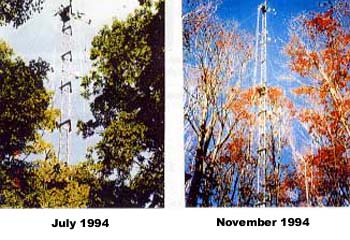
General site details
| Site name | Takayama deciduous broadleaf forest site |
|---|---|
| AsiaFlux site code | TKY |
| Location | Takayama, Gifu, Japan |
| Position | 36º 08' 46.2" N, 137º 25' 23.2" E (WGS84) |
| Elevation | 1420 m above sea level (WGS84) |
| Slope | 5-15º |
| Terrain type | Complex terrain |
| Area | 50,000 m2 |
| Fetch | 300~1000 m (depending on wind direction) |
| Climate | Cool temperate (Snow - fully humid - warm summer (Dfb)) |
| Mean annual air temperature | 6.7 ºC (mean of 1994-2022 at the flux tower) |
| Mean annual precipitation | 2275 mm (mean of 1980-2002, data from the Takayama Research Station of IBES, ca. 500 m south of the flux tower) |
| Vegetation type | Cool temperate deciduous forest |
| Dominant Species (Overstory) | Birch (Betula), Deciduous oak (Quercus crispula Blume) |
| Dominant Species (Understory) | Bamboo grass (Sasa senanensis (Franch. et Sav.) Rehd.) |
| Canopy height | 15-20 m |
| Age | 60-70 years (as of 2023) |
| LAI | Trees (about 5.5 m2 m-2 from June to September), bamboo bush (about 1.7 m2 m-2) |
| Soil type | Brown forest soil (Dystric Cambisol) |
Observation
Eddy Covariance method (CO2)
| System | Closed-path system |
|---|---|
| Wind speed | Three-dimensional sonic anemometer-thermometer (DA600-3TV (Probe TR-61A), KAIJO) |
| Air temperature | Three-dimensional sonic anemometer-thermometer (DA600-3TV (Probe TR-61A), KAIJO) |
| Water vapor | Closed-path CO2/H2O analyzers (LI-6262, LI-COR) |
| CO2 | Closed-path CO2/H2O analyzers (LI-6262, LI-COR) |
| Measurement height | 25 m |
| Sampling frequency | 5 Hz |
| Averaging time | 30 min |
| Data logger | (1998 - Mar. 2008) DRM3a, TEAC, Japan (Mar. 2008 - present) CR3000, Campbell Scientific, USA |
| Data storage | (1998 - Mar. 2008) Magneto-Optical Disk (Mar. 2008 - present) Compact Flash Memory |
| Original data | Raw data |
Meteorology
| Observation items | Levels/Depth | Instrument |
|---|---|---|
| Global solar radiation (incoming) | 25.5 m | (1998 - Mar. 2008) Albedo meter, MR21, EKO (Mar. 2008 - present) Net radiometer, MR-50, EKO |
| Global solar radiation (outgoing) | 25.5 m | (1998 - Mar. 2008) Albedo meter, MR21, EKO (Mar. 2008 - present) Net radiometer, MR-50, EKO |
| Long-wave radiation(incoming) | 24.5 - 25.5 m | (1998 - Mar. 2008) Albedo meter, MR21, EKO and Infrared radiometer, MS201, EKO (Mar. 2008 - present) Net radiometer, MR-50m, EKO |
| Long-wave radiation(outgoing) | 24.5 - 25.5 m | (1998 - Mar. 2008) Albedo meter, MR21, EKO and Infrared radiometer, MS201, EKO (Mar. 2008 - present) Net radiometer, MR-50m, EKO |
| Net radiation | 24.5 - 25.5 m | (1998 - Mar. 2008) Albedo meter, MR21, EKO and Infrared radiometer, MS201, EKO (Mar. 2008 - present) Net radiometer, MR-50m, EKO |
| PPFD (incoming) | Above canopy, 2.0 m | Above canopy: Estimated from meteorological data (Mizoguchi et al., 2014, https://doi.org/10.1007/s00704-013-0912-2) 2.0 m: (1998 - 2018) Quantum sensor, IKS27, Koito (2019) no available data (2020 - present) Quantum sensor, SQ-110, Apogee |
| PPFD (outgoing) | 19.5 m | (1998 - Oct.2018) Quantum sensor, IKS27, Koito (Oct.2018 - present) Quantum sensor, SQ-110, Apogee |
| Direct / diffuse radiation | - | - |
| Direct / diffuse PPFD | - | - |
| Air temperature | 25, 18, 10 m | (1998 - Mar. 2008) Platinum resistance thermometer, HMP233, Vaisala (Mar. 2008 - present) Platinum resistance thermometer, HMP45A, Vaisala |
| Humidity | 25, 18, 10 m | (1998 - Mar. 2008) Humicap hygrometer, HMP233, Vaisala (Mar. 2008 - present) Humicap hygrometer, HMP45A, Vaisala |
| Soil temperature | 0.01, 0.1, 0.2, 0.5 m | 0.01 m: Platinum resistance thermometer, MT-010S, EKO 0.1, 0.2, 0.5 m: (1998 - May 2009) Platinum resistance thermometer, MT-010S, EKO (May 2009 - present) Platinum resistance thermometer, C-PTG-10, Climatec |
| Soil heat flux | 0.02 m | Soil heat flux plate, MF81, EKO |
| Soil water content | 0.15, 0.4 m | 0.15 m: (1998 - Oct. 2010) TDR soil water content sensor, CS615, Campbell (Oct. 2010 - present) TDR soil water content sensor, CS616, Campbell 0.4 m: (1998 - Aug. 2012) TDR soil water content sensor, CS615, Campbell (Aug. 2012 - present) TDR water content sensor, CS616, Campbell It is calibrated occasionally by oven drying of soil samples. |
| Wind speed | 25, 10 m | Combined wind vane and fan anemometer, MA-110, EKO |
| Wind direction | 25, 10 m | Combined wind vane and fan anemometer, MA-110, EKO |
| Barometric pressure | 1.5 m | (1998 - Jan. 2005) Barometer, 1332A-10, Rosemount (Jan. 2005 - May 2014) Barometer, PMP4060, Druck (May 2014 - Feb. 2019) Barometer, RPT410, Druck (Feb. 2019 - present) Barometer, PTB110, Vaisala |
| Precipitation | None at the site, but obtained from nearby stations. | |
| CO2 concentration | 27, 18, 8.8, 5.8, 2, 1.3 m | (1998 - Aug. 2003) Non dispersive infrared gas analyzer, Model 880, Beckman (Aug. 2003 - present) Non dispersive infrared gas analyzer, LI-6252 or LI-6262, LI-COR |
Soil respiration
| Measurement method | Continuous measurement: (1994-2005) Open-flow Chamber System (OF); (2005-2013) Automated Chamber System (AOCC); Periodical measurements: Closed-chamber method (CC) with 100 points |
| References for method | OF: Mo et al. (2005); AOCC: Kishimoto-Mo et al. (2015); CC: Jia et al. (2003). |
| Measuring system | OF: Li-6262 attached with self-made open flow system; AOCC: BINOS attached with an automated chamber and flow system; CC: Manual gas sampling with syringe and vacuum vials and offline analysis using GC (TCD detector). |
| IRGA | See above |
| Flow control | OF: 1.0-1.2 L/min; AOCC: 1.35 L/min |
| Chamber type | Round, PVC |
| Chamber size | OF/CC: 21 cm in internal diameter and 15 cm in height, and set 5 cm into the soil; AOCC: 20 cm internal diameter, 25 cm tall, and set 5 cm into the soil. |
| Number of chambers | OF: 4; AOCC: 4-5; CC: 100 |
| Measuring intervals | OF: daily measurement in every week or twice weeks; AOCC: continuously measurement in snow-free season; CC: September of 1999 and 2000 |
| Is the ground covered by snow in winter? | Yes; reference to Mariko et al. (2000), Mo et al. (2015), Yonemura et al. (2013), Sakurai et al. (2015). |
| Original data | Statistics |
| Temperature and air pressure correction | Chamber temperature and onsite air pressure for OF and AOCC; CC flux calculation using chamber temperature. |
Other
| Soil Respiration | |
| Photosynthesis | Periodical measurements for canopy and shrub tree species, and dwarf bamboo grass in understory (A-Ci curve by LI-6400) |
| Ecological Investigation Individual tree biomass by DBH measurement once per | Individual tree biomass by DBH measurement once per year Litter fall measurements (14 x 1m2) Fine root biomass and growth by mini-rhizotron |
| LAI | Obtained from Plant Canopy Analyzer on an occasional basis, while calculated on a continuous basis from the attenuation of PAR |
| Air sampling | CO2 concentration and its carbon and oxygen isotopic ratios, and O2/N2 and Ar/N2 ratios. |
| O2/N2 ratio | Continuous measurement: (2021-) |
Observation Period and Data Availability
| Measurement Period | September 28, 1993 to present |
|---|---|
| Measurement Frequency | Continuous |
| Data Availability | 1998-2021 in AsiaFlux Database [CO2 concentration] World Data Centre for Greenhouse Gases (WDCGG) |
Contact
[General] Shohei Murayama (s.murayama[at]aist.go.jp)
National Institute of Advanced Industrial Science and Technology (AIST)
AIST Tsukuba West, 16-1 Onogawa, Tsukuba, Ibaraki 305-8569 Japan
TEL: + 81-29-861-8320 FAX: + 81-29-861-8358
[Flux] Nobuko Saigusa (n.saigusa[at]nies.go.jp)
National Institute for Environmental Studies (NIES)
16-2, Onogawa, Tsukuba, Ibaraki 305-8506 Japan
TEL: +81-29-850-2517 FAX: +81-29-858-2645
[Soil respiration, Photosynthesis, Ecological Investigation]
Hiroyuki Muraoka (muraoka.hiroyuki.y6[at]f.gifu-u.ac.jp)
River Basin Research Center, Gifu University
1-1 Yanagido, Gifu 501-1193 Japan
[CO2 concentration] Shohei Murayama (s.murayama[at]aist.go.jp) National Institute of Advanced Industrial Science and Technology (AIST)
[Micrometeorology] Hiroaki Kondo (kondo-hrk[at]aist.go.jp) [O2/N2 and Ar/N2 ratios] Shigeyuki Ishidoya (s-ishidoya[at]aist.go.jp)
Infrastructure
Tower, Electrical power (AC)
Research Fund
The Global Environment Research Coordination System from the Ministry of the Environment, Japan (Grant Number MAFF0751, MAFF1251, MAFF2254)
The Global Environment Research Fund of the Ministry of the Environment, Japan (S-1)
JSPS KAKENHI
Publication
The updated publications from 1999 to 2023.
Please click here -> Publications_TKY.pdf.
Hirata et al. (2008) Spatial distribution of carbon balance in forest ecosystems across East Asia. Agricultural and Forest Meteorology 148: 761-775
Ito et al. (2006) Seasonal variation in leaf properties and ecosystem carbon budget in a cool-temperate deciduous broad-leaved forest: simulation analysis at Takayama site, Japan. Ecological Research 21:137-149.
Ito et al. (2007) Examination of model-estimated ecosystem respiration by use of flux measurement data from a cool-temperate deciduous broad-leaved forest in central Japan. Tellus 59B, 616-624
Jia et al. (2003) Temporal and spatial variability of soil respiration in a cool temperate broad-leaved forest. 1. Measurement of spatial variance and factor analysis. Japanese Journal of Ecology 53: 13-22. (in Japanese with English abstract)
Kodo et al. (2001) A numerical simulation of the daily variation of CO2 in the central part of Japan -summer case-, Journal of Meteorological Society of Japan., 79, 11-21.
Kondo et al. (2005) Refixation of respired CO2 by understory vegetation in a cool-temperate deciduous forest in Japan. Agricultural and Forest Meteorology 134: 110-121
Lee et al. (2002) Effects of rainfall events on soil CO2 flux in a cool temperate deciduous broad-leaved forest. Ecological Research 17: 401-409.
Lee et al. (2003) Seasonal changes in the contribution of root respiration to total soil respiration in a cool-temperate deciduous forest. Plant and Soil 255: 311-318
Lee et al. (2005) The importance of root respiration in annual soil carbon fluxes in a cool-temperate deciduous forest. Agricultural and Forest Meteorology 134: 95-101.
Lee et al. (2006) Soil respiration of forest ecosystems in Japan and global implications. Ecological Research 21: 828-839.
Mariko et al. (2000) Measurement of CO2 fluxes from soil and snow surfaces with open dynamic chamber technique. Environmental Sciences 13: 69-74.
Mariko et al. (2000) Winter CO2 flux from soil and snow surfaces in a cool-temperate deciduous forest, Japan. Ecological Research 15: 363-372
Mikami et al. (2006) Automatic detection of forest canopy gaps and estimation of leaf area index (LAI) using the digital fish-eye camera's images. Journal of the Japan Society of Photogrammetry and Remote Sensing 45: 13-22. (in Japanese with English abstract)
Mo et al. (2005a) Interannual variation in CO2 effluxes from soil and snow surfaces in a cool-Temperate deciduous broad-leaved forest. Phyton 45 (4): 99-107.
Mo et al. (2005b) Seasonal and annual variations in soil respiration in a cool-temperate deciduous broad-leaved forest in Japan. Agricultural and Forest Meteorology 134: 81-94.
Muraoka & Koizumi (2005) Photosynthetic and structural characteristics of canopy and shrub trees in a cool-temperate deciduous forest: implication to the ecosystem carbon gain. Agricultural and Forest Meteorology 134: 39-59.
Muraoka H & Koizumi H (2006) Leaf and shoot ecophysiological properties and their role in photosynthetic carbon gain of cool-temperate deciduous forest trees. In: Kawatata H and Awaya Y (eds.) Global climate change and response of carbon cycle in the Equatorial Pacific and Indian Oceans and adjacent landmasses. Elsevier Oceanography series vol. 73, Elsevier, pp.417-443
Murayama et al. (2003) Temporal variations of atmospheric CO2 concentration in a temperate deciduous forest in central Japan. Tellus 55B: 232-243.
Murayama et al. (2005) Statistical analyses of inter-annual variations in the vertical profile of atmospheric CO2 concentration and carbon budget in a cool-temperate deciduous forest in Japan, Agricultural and Forest Meteorology 134: 17-26.
Nishimura et al. (2004) Evaluation of carbon budgets of a forest floor Sasa senanensis community in a cool-temperate forest ecosystem, central Japan. Japanese Journal of Ecology 54: 143-158. (in Japanese with English abstract)
Noguchi et al. (2007),Biomass and production of fine roots in Japanese forests. Journal of Forest Research 12: 83-95.
Ohtsuka et al. (2005) Biometric based estimates of net primary production (NPP) in a cool-temperate deciduous forest stand beneath a flux tower. Agricultural and Forest Meteorology 134: 27-38.
Saigusa et al. (2002) Gross primary production and net ecosystem production of a cool-temperate deciduous forest estimated by the eddy covariance method. Agricultural and Forest Meteorology 112: 203-215.
Saigusa et al. (2005) Inter-annual variability of carbon budget components in an AsiaFlux forest site estimated by long-term flux measurements. Agricultural and Forest Meteorology 134: 4-16.
Saigusa et al. (2005) Inter-annual variability of carbon budget components in a cool-temperate deciduous forest in Japan (Takayama, AsiaFlux). Phyton 45: 81-88.
Saigusa et al. (2008) Temporal and spatial variations in the seasonal patterns of CO2 flux in boreal, temperate, and tropical forests in East Asia. Agricultural and Forest Meteorology 148: 700-713
Sakai & Akiyama (2005) Quantifying the spatio-temporal variability of net primary production of the understory species, Sasa senanesis, using multipoint measuring techniques. Agricultural and Forest Meteorology 134: 60-69.
Sakai et al. (2005) Microsite variation in light availability and photosynthesis in a cool-temperate deciduous broadleaf forest in central Japan. Ecological Research 20: 537-545.
Sakai et al. (2006) The contribution of gross primary production of understory dwarf bamboo, Sasa senanensis, in a cool-temperate deciduous broadleaf forest in central Japan. Forest Ecology and Management 236: 259-267.
Satomura et al. (2006) Seasonal patterns of fine root demography in a cool-temperate deciduous forest in central Japan. Ecological Research 21: 741-753.
Uchida et al. (2005) Microbial activity and litter decomposition under snow cover in a cool-temperate broad-leaved deciduous forest. Agricultural and Forest Meteorology 134: 102-109.
Yamaji et al. (2008) Scaling-up technique for net ecosystem productivity of deciduous broadleaved forests in Japan using MODIS data, Ecological Research, 23, 765-775
Yamamoto et al. (1999) Seasonal and inter-annual variation of CO2 flux between a temperate forest and the atmosphere in Japan. Tellus 51B: 402-413.