

NSS: National Institute of Livestock and Grassland Science,Nasu Research Station
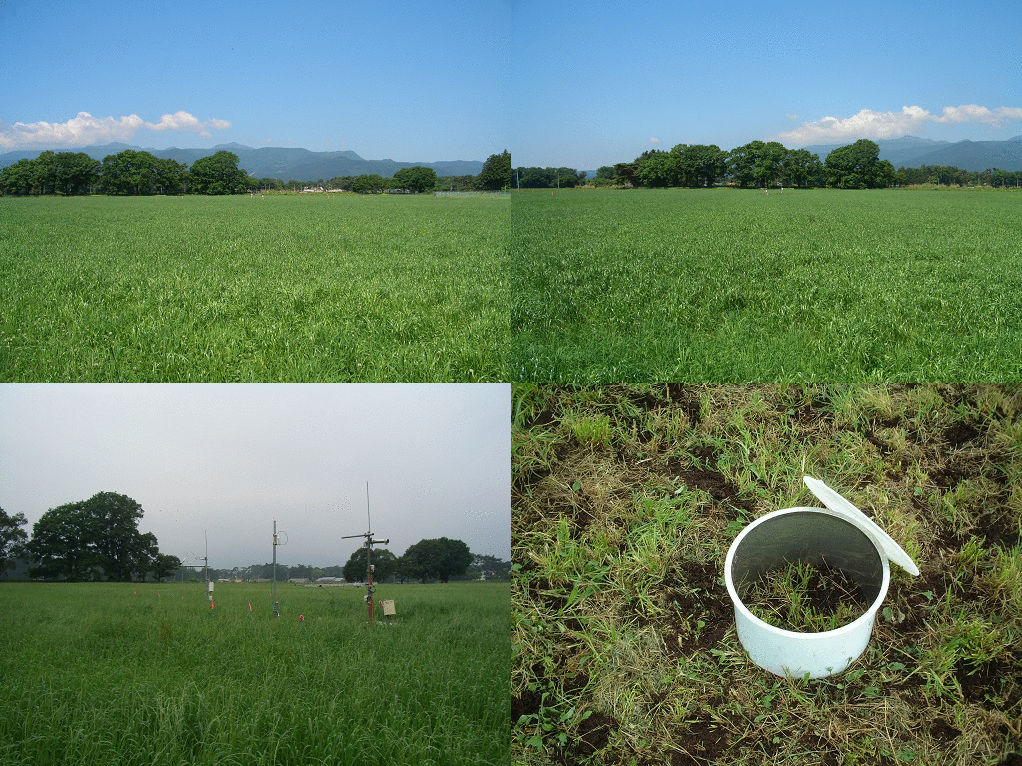
General site details
| Site name | National Institute of Livestock and Grassland Science,Nasu Research Station |
|---|---|
| AsiaFlux site code | NSS |
| Location | Senbonmatsu, Nasushiobara, Tochigi, Japan |
| Position | 36º 55' N, 139º 58' E |
| Elevation | 320 m above sea level |
| Slope | mostly horizontal |
| Terrain type | almost flat |
| Area | about 64 m (Chemical fertilizer plot) and about 70 m (Manure plot) |
| Fetch | about 64 m (Chemical fertilizer plot) and about 70 m (Manure plot) |
| Climate | warm temperate, Cfa |
| Mean annual air temperature | 12.0 deg C (1985-2000) |
| Mean annual precipitation | 1561.0 mm (1971-2000) |
| Vegetation type | hay meadow |
| Dominant Species (Overstory) | Orchardgrass (Dactylis glomerata), Italian lyegrass (Lolium multiflorum Lam.) |
| Dominant Species (Understory) | - |
| Canopy height | 120 cm |
| Age | 6 years in 2008 |
| LAI | - |
| Soil type | Medium and Coarse textured Brown Lowland soils (Typic Dystrudepts) |
Observation
Eddy Covariance method (CO2)
| System | Open-path system |
|---|---|
| Wind speed | Sonic anemometer-thermometer (CSAT3, Campbell Scientific) |
| Air temperature | Sonic anemometer-thermometer (CSAT3, Campbell Scientific) |
| Water vapor | NDIR (LI-7500, Li-Cor) |
| CO2 | NDIR (LI-7500, Li-Cor) |
| Measurement height | 2.5 m (Chemical fertilizer plot) and 2.3 m (Manure plot) |
| Sampling frequency | 10 Hz |
| Averaging time | 30 min |
| Data logger | CR23X (Campbell Scientific), CR1000 (Campbell Scientific) |
| Data storage | CF |
| Original data | Raw data |
Meteorology
| Observation items | Levels/Depth | Instrument |
|---|---|---|
| Global solar radiation(incoming) | 1.5 m | Non ventilated radiometer (Kipp & Zonen, CNR-1) |
| Global solar radiation (outgoing) | 1.5 m | Non ventilated radiometer (Kipp & Zonen, CNR-1) |
| Long-wave radiation(incoming) | 1.5 m | Non ventilated radiometer (Kipp & Zonen, CNR-1) |
| Long-wave radiation(outgoing) | 1.5 m | Non ventilated radiometer (Kipp & Zonen, CNR-1) |
| Net radiation | 1.5 m | Non ventilated radiometer (Kipp & Zonen, CNR-1) |
| PPFD (incoming) | 1.5 m | Quantum sensor (ML-020, EKO) |
| PPFD (outgoing) | 1.5 m | Quantum sensor (LI-190SA, Li-Cor) |
| Direct / diffuse radiation | - | |
| Direct / diffuse PPFD | - | |
| Air temperature | 2.3 m | Ventilated Pt resistance thermometer (HMP-45A, Vaisala) |
| Humidity | 2.3 m | Capacitive hygrometer (HMP45A, Vaisala) |
| Soil temperature | -0.05, -0.1 m | T-type thermocoupule (T-soil4, Meiwafosis |
| Soil heat flux | -0.02 to -0.03 m | Soil heat sensor (MF-81, EKO) |
| Soil water content | -0.05, -0.1 m | Dielectric aquameter (EC20, DECAGON) |
| Wind speed | 2.3, 2.5 m | Sonic anemometer-thermometer (CSAT3, Campbell Scientific) |
| Wind direction | 2.3, 2.5 m | Sonic anemometer-thermometer (CSAT3, Campbell Scientific) |
| Barometric pressure | 1.3 m, 1.1 m | Sonic anemometer-thermometer (CSAT3, Campbell Scientific) |
| Precipitation | 0.54 m | Rain gauge |
| CO2 concentration | 2.3, 2.5 m | NDIR (LI-7500, Li-Cor) |
Other
| Soil respiration | Static closed chamber |
| Methane (CH4) | Static closed chamber (biweekly) 2004- |
| Nitrous oxide (NO2) | Static closed chamber (biweekly) 2004- |
Other Information
| Chemical fertilizer plot and manure plot were established in August 2004. Grasses were harvested four times per year.Chemical fertilizer and manure application. The grasslands were renovated in September 2007.[Chemical fertilizer plot] Chemical fertilizer: 198-209 kg N ha-1, [Manure plot] Manure: 15-32 FM t ha-1, Chemical fertilizer: 156-210 kg N ha-1 |
Observation Period and Data Availability
| Measurement Period | from August 2004 to present |
|---|---|
| Measurement Frequency | Continuous |
| Data Availability | N/A |
Contact
Yoshiki YAMAMOTO (yoshiki [at] affrc.go.jp) Shoji MATSUURA (shojim [at] affrc.go.jp) Seiji NAKAOKA (snakao [at] affrc.go.jp) Akinori MORI (amori [at] affrc.go.jp) National Institute of Livestock and Grassland Science768 Senbonmatsu, Nasushiobara, Tochigi, 329-2793, Japan TEL: +81-287-37-7807 FAX: +81-287-36-6629
Infrastructure
2.5 m (Chemical fertilizer plot) and 2.3 m (Manure plot) high tower, AC 100V
Research Fund
Research grants from Racing and Livestock Association organized by Japan Grassland Agriculture & Forage Seed Association for the Greenhouse Gas Emissions Mitigation Project in Japanese Grasslands
Calibration Information
NDIRs were calibrated every year with standard CO2 gasses and a dew point generator (LI-610, Li-Cor)