

KBU: Kherlenbayan Ulaan
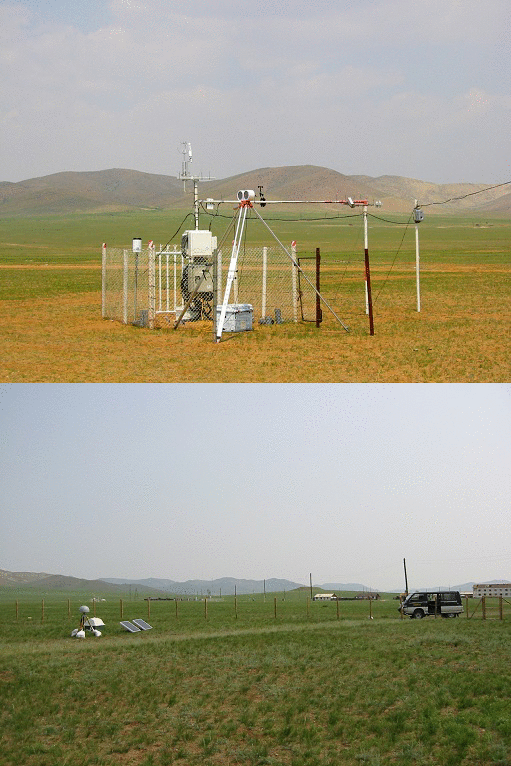
General site details
| Site name | Kherlenbayan Ulaan |
|---|---|
| AsiaFlux site code | KBU |
| Location | village of Kherlenbayan Ulaan, Mongolia |
| Position | 47º 12' 50.3" N, 108º 44'14.4" E (World Geodetic System 1984) |
| Elevation | 1235 m above sea level (World Geodetic System 1984) |
| Slope | plane and flat |
| Terrain type | Flat |
| Area | - |
| Fetch | 240 m for SW, more than 800 for other directions |
| Climate | cold and semi-arid (arid - steppe - cold arid [BSk] (Kottek et al. 2006)) |
| Mean annual air temperature | 1.2 ºC |
| Mean annual precipitation | 196mm ( 1993-2003 at IMH station) |
| Vegetation type | Uniform grassland |
| Dominant Species (Overstory) | Stipa krylovii, Carex sp., caragana stenophylla, Cleistogenes squarrosa, Artemisia frigida |
| Dominant Species (Understory) | - |
| Canopy height | up to 0.1 to 0.2 m |
| Age | - |
| LAI | less than 1 |
| Soil type | Chestnut soil (Katanozem) |
Observation
Eddy Covariance method (CO2)
| System | Open-path system (CO2 flux, latent heat flux) |
|---|---|
| Wind speed | Kaijo SAT-550 |
| Air temperature | Kaijo SAT-550 |
| Water vapor | Open path(LI-7500, Li-Cor, USA) |
| CO2 | Open path(LI-7500, Li-Cor, USA) |
| Measurement height | 3.5 m |
| Sampling frequency | 10 Hz |
| Averaging time | 30 min |
| Data logger | CR-23x (Campbell, USA) |
| Data storage | CR-23x (Campbell, USA) |
| Original data | statistics only |
| Scintillometer | available only in 2003 |
Meteorology
| Observation items | Levels/Depth | Instrument |
|---|---|---|
| Global solar radiation(incoming) | 2.5 m | Four-component net radiometer,CNR1 ( Kipp & Zonen ) |
| Global solar radiation (outgoing) | 2.5 m | Four-component net radiometer,CNR1 ( Kipp & Zonen ) |
| Long-wave radiation(incoming) | 2.5 m | Four-component net radiometer,CNR1 ( Kipp & Zonen ) |
| Long-wave radiation(outgoing) | 2.5 m | Four-component net radiometer,CNR1 ( Kipp & Zonen ) |
| Net radiation | - | |
| PPFD (incoming) | - | |
| PPFD (outgoing) | - | |
| Direct / diffuse radiation | - | |
| Direct / diffuse PPFD | - | |
| Air temperature | 2.4 m | Temperature-humidity sensor, HMP45 (Vaisala) |
| Humidity | 2.4 m | Temperature-humidity sensor, HMP45 (Vaisala) |
| Soil temperature | -0.05, -0.1, -0.2, -0.3, -0.5, -0.7, -1, -1.5m | C-PT, CLIMATEC Inc |
| Soil heat flux | -2, -10 m | PHF-1.1, REBS, Inc |
| Soil water content | -0.1, -0.2, -0.3, -0.7, -1, -1.5 m | CS616, Campbell Scientific |
| Wind speed | - | |
| Wind direction | - | |
| Barometric pressure | - | Campbell PTB101 |
| Precipitation | - | CYG-52202, RM Young Company |
| CO2 concentration | - | |
| H2O concentration | - |
Other
| Soil respiration | - |
| Photosynthesis | - |
| Ecological investigation | - |
Observation Period and Data Availability
| Measurement Period | from March 2003 to present |
|---|---|
| Measurement Frequency | Continuous |
| Data Availability | 2003-2009 in AsiaFlux Database |
Contact
Jun Asanuma (asanuma [at]suiri.tsukuba.ac.jp)
Terrestrial Environment Research CenterUniversity of Tsukuba Tsukuba, Ibaraki 305-8577, Japan
Tel:+81-298-53-6704 Fax:+ 81-298-53-6704
Sheng-Gong Li (lisg [at] igsnrr.ac.cn)
Synthesis Research Center of Chinese Ecosystem Research Network (CERN)Institute of Geographic Sciences and Natural Resources Research (IGSNRR),Chinese Academy of Sciences (CAS),
DaTun Road A11, Anwai Street , ChaoYang DistrictBeijing, China PR, 100101
Tel: +86-10-64889039
Gombo Davaa (watersecta [at] yahoo.com)
Institute of Meteorology and HydrologyHudaldannyi St.-5,
Ulaanbaatar 46, Mongolia
+976-11-312765+976-11-326611
Infrastructure
Fense, electric power, pole
Research Fund
The rangelands atmosphere-hydrosphere-biosphere interaction study experiment in north-eastern Asia (RAISE) project through financial support from Japan Science and Technology Agency (2003-2006)
Calibration Information
Calibration once a year.
Publication
Sugita, M., Asanuma, J., Tsujimura, M., Mariko, S., Lu, M., Kimura, F.,Azzaya, D., and Adyasuren, T., 2007: An overview of the rangelands atmosphere-hydrosphere-biosphere interaction study experiment in northeastern asia (RAISE). Journal of Hydrology, Vol. 333, pp. 3-20.
S.-G. Li, J. Asanuma, W. Eugster, A. Kotani, G. Davaa, D. Oyunbaatar and M. Sugita (2005) Net ecosystem carbon dioxide exchange over grazed steppe in central Mongolia, Global Change Biology, online: 11, doi: 10.1111/j.1365-2486.2005.01047.x
Asanuma J. and K. Iemoto (2006) Measurements of regional sensible heat flux over Mongolian grassland using large aperture scintillometer. Journal of Hydrology, 333, 58-67, doi:10.1016/j.jhydrol.2006.07.031
Mariko S., T. Urano and J. Asanuma(2006): Effects of irrigation on CO2 and CH4 fluxes from Mongolian steppe soil. Journal of Hydrology, 333, 118-123, doi:10.1016/j.jhydrol.2006.07.027
S.-G. Li, J. Asanuma, A. Kotani, G. Davaa and D. Oyunbaatar(2006): Evapotranspiration from a Mongolian steppe under grazing and its environmental constraints. Journal of Hydrology, 333, 133-143, doi:10.1016/j.jhydrol.2006.07.021
Li, Sheng-Gong, and Eugster, Werner, and Asanuma, Jun and Kotani, Ayumi and Davaa, Gombo and Oyunbaatar, Dambaravjaa and Sugita, Michiaki, 2006, Energy partitioning and its biophysical controls above a grazing steppe in central Mongolia, afm, 137, 89-106
Li, S.-G. and W. Eugster and Asanuma, J. and A. Kotani and G. Davaa and D. Oyunbaatar and M. Sugita, 2008, Response of gross ecosystem productivity, light use efficiency, and water use efficiency of Mongolian steppe to seasonal variations in soil moisture, jgr-b, 113, G01019, doi:10.1029/2006JG000349