

FHK: Fuji Hokuroku Flux Observation Site
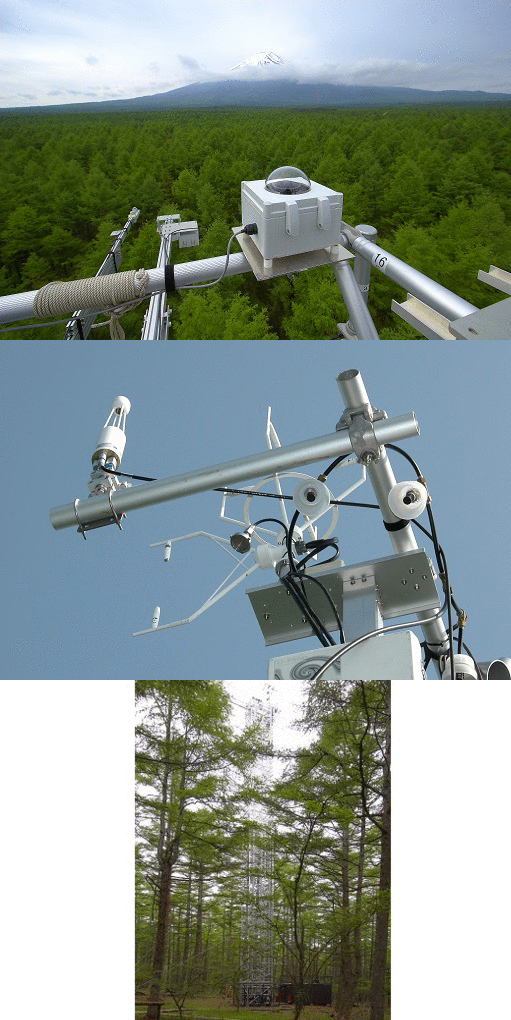
General site details
| Site name | Fuji Hokuroku Flux Observation Site |
|---|---|
| AsiaFlux site code | FHK |
| Location | Fujiyoshida City, Yamanashi Pref, Japan |
| Position | 35º 26' 36.8"N, 138º 45' 53.0"E (revised Jan. 8, 2025) |
| Elevation | 1050-1150 m above sea level |
| Slope | 3-4 deg |
| Terrain type | Flat |
| Area | 150 ha |
| Fetch | - |
| Climate | Cfa:Temperate - mild with no dry season, hot summer |
| Mean annual air temperature | 8.9 deg C (2006-2023, at a height of 2m) |
| Mean annual precipitation | 1831 mm (2006-2023) |
| Vegetation type | Deciduous needleleaf forest (Japanese larch afforestation) |
| Dominant Species (Overstory) | Japanese larch (Larix Kaempferi Sarg.), evergreen needle-leafed species (Pinus densiflora and Abies homolepis), deciduous broad-leafed species (Swida controversa, Quercus serrata, Quercus crispula, Betula platyphylla var.japonica, Prunus incisa, etc.) |
| Dominant Species (Understory) | Ferns (Dryopteris crassirhizoma, Dryopteris expansa), bamboo grass (Sasamorpha borealis), and other herbs. |
| Canopy height | 20-26 m |
| Age | Around 70 years old (Planted around 1950) |
| LAI | Larch: 2.88 m2m-2 estimated based on the leaf mass abundance (Okano & Arase 2007), and 2.4 m2m-2 estimated based on 3D portable laser scanner measurement (Maki et al., 2012), Understory: 3.0 m2m-2 (max) After thinning, the tree LAI was 2.31 in 2016. |
| Soil type | Coarse volcanic ash (Urakawa et al., 2015) |
| Disturbance | As the first thinning, approximately 36% of the larch trees located more than 20 meters away from the observation tower were cut down in May 2014. The second thinning was carried out near the observation tower in March 2015. Between 2014 to 2015, approximately 39% of the larch trees were cut down, reducing the forest density from 409 trees per hectare in 2013 to 249 trees per hectare in 2015. The harvested timber and above-ground residues were removed from the site. |
Observation
Eddy Covariance method (CO2)
| System | Open- and closed-path systems (CO2 flux, latent heat flux) |
|---|---|
| Wind speed | Three-dimensional sonic anemometer-thermometers: DA-600-3TV, Probe TR-61C, SONIC CORP. (Jan.1, 2006- May 9, 2011); DA-650-3TV, Probe TR-61C, SONIC CORP. (May 9, 2011- Nov.22, 2011); DA-600-3TV, Probe TR-61C, SONIC CORP. (Nov.22, 2011- Apr.18, 2012); DA-700-3TV, Probe TR-61A, SONIC CORP. (Apr.18, 2012- Apr.11 2016); CSAT3, Campbell Scientific (Apr. 14, 2014-) |
| Air temperature | Platinum resistance thermometer and capacitive hygrometer : HMP45A, Vaisala (Jan. 2006 - May 9, 2011); HPM155A, Vaisala (May 9, 2011 - ) coupled with aspirated radiation shield, CPR-AS-21, Climatec, Japan. |
| Water vapor | Open-path CO2/H2O analyzers, LI-7500, LI-COR (Jan.1, 2006); LI-7000, LI-COR (Jan. 1, 2012-Apr. 11, 2016) Closed-path CO2/H2O analyzers, LI-6262, LI-COR (Jan.1, 2006- Apr.11, 2016) Platinum resistance thermometer and capacitive hygrometer : HMP45A, Vaisala (Jan. 2006-May 9, 2011); HMP155A, Vaisala (May 9, 2011- ) coupled with aspirated radiation shield, CPR-AS-21, Climatec, Japan |
| CO2 | Open-path CO2/H2O analyzer, LI-7500, LI-COR (Jan.1, 2006- ), Closed-path CO2/H2O analyzer, LI-6262, LI-COR (Jan.1, 2006- Apr.11, 2016); LI-7000, LI-COR (Apr. 19, 2012- ) |
| Measurement height | 35 m |
| Sampling frequency | 10 Hz |
| Averaging time | 30 min |
| Data logger | DR-M3, TEAC, Japan (Jan.2006-March 2012); CR-23X, Campbell Scientific, USA (Jan.2006 - April 2008); CR-3000, Campbell Scientific, USA (May 2008-) |
| Data storage | Magneto-Optical Disk (TEAC); Data-logger CR-3000, Campbell Scientific, USA |
| Original data | Raw data |
Meteorology
| Observation items | Levels/Depth | Instrument |
|---|---|---|
| Global solar radiation (incoming) | 32 m, 30 m | Pyranometer (32m): MS-402F, Eko, Japan (Jan. 2006 - Apr. 15, 2015); CMP6, Kipp&Zonen, Netherland (Apr. 15, 2015 -), Radiometer (30m): MR-50, Eko, Japan (Jan. 2006 to Nov. 16, 2015); NR01, Hukseflux, Netherland (Nov. 16, 2015 -) |
| Transmitted solar radiation (below canopy incoming) | 2 m (5 points), 2 m (2 points) | Pyranometer (5 points): MS-601, Eko, Japan (Jan. 2006 - Apr. 15, 2015); CMP6, Kipp&Zonen, Netherland (Apr. 15, 2015 -) Radiometer: MR-50, Eko, Japan (Jan. 2006 - Apr. 12, 2018; Jan. 2006 - Apr. 10, 2017); NR01, Hukseflux, Netherland (Apr. 12, 2018 - ; Apr. 10, 2017 -) |
| Global solar radiation (outgoing) | 30 m | Radiometer: MR-50, Eko (Jan. 2006 - Nov. 16, 2015); NR01, Hukseflux, Netherland (Nov. 16, 2015 -) |
| Transmitted solar radiation (below canopy outgoing) | 2 m (2 points) | Radiometer: MR-50, Eko (Jan. 2006 - Apr. 12, 2018; Jan. 2006 - Apr. 10, 2017); NR01, Hukseflux, Netherland (Apr. 12, 2018 -; Apr. 10, 2017 -) |
| Long-wave radiation (incoming) | 30 m | Radiometer: MR-50, Eko (Jan. 2006 - Nov. 16, 2015); NR01, Hukseflux, Netherland (Nov. 16, 2015 -) |
| Transmitted long-wave radiation (below canopy incoming) | 2 m (2 points) | Radiometer: MR-50, Eko (Jan. 2006 - Apr. 12, 2018; Jan. 2006 - Apr. 10, 2017); NR01, Hukseflux, Netherland (Apr. 12, 2018 - ; Apr. 10, 2017 -) |
| Long-wave radiation (outgoing) | 30 m | Radiometer: MR-50, Eko (Jan. 2006 - Nov. 16, 2015); NR01, Hukseflux, Netherland (Nov. 16, 2015 -) |
| Transmitted long-wave radiation (below canopy outgoing) | 2 m (2 points) | Radiometer: MR-50, Eko (Jan. 2006 - Apr. 12, 2018; Jan. 2006 - Apr. 10, 2017); NR01, Hukseflux, Netherland (Apr. 12, 2018 - ; Apr. 10, 2017 -) |
| Net radiation | 30 m | Radiometer: MR-50, Eko (Jan. 2006-Nov. 16, 2015); NR01, Hukseflux, Netherland (Nov. 16, 2015-) |
| Net radiation | 2 m (2 points) | Radiometer: MR-50, Eko (Jan. 2006- Apr. 12, 2018; Jan. 2006- Apr. 10, 2017); NR01, Hukseflux, Netherland (Apr. 12, 2018-; Apr. 10, 2017-) |
| PPFD (incoming) | 32 m | Quantum sensor: LI-190S, LI-COR (Jan. 2006 - Apr. 16, 2015); LI-190S, LI-COR encased in a weather-proof external housing with a glass dome (Apr. 16, 2015 -) (Akitsu et al., 2020); ML-020P, Eko, Japan (Jan. 2006 - Apr. 15, 2013); SQ-110, Apogee, USA (Apr. 15, 2013 -) |
| Transmitted PAR (below canopy incoming) | 2 m (5 points) | Quantum sensor: LI-190S, LI-COR (Jan. 2006 - Mar. 2007); ML-020P, Eko (Mar. 2007 - Apr. 15, 2013); SQ-110, Apogee, USA (Apr. 15, 2013 -) |
| Reflected PAR (outgoing) | 30 m | Quantum sensor: LI-190S, LI-COR (Jan. 2006-Mar. 2007); ML-020P, Eko (Mar. 2007-Apr. 15, 2013); SQ-110, Apogee, USA (Apr. 15, 2013-); LI-190S, LI-COR encased in a weather-proof external housing with a glass home (Apr. 12, 2018-) (Akitsu et al., 2020) |
| Reflected PAR (below canopy outgoing) | 2 m (3 points) | Quantum sensor: LI-190S, LI-COR (Jan.2006-Mar.2007); ML-020P, Eko (Mar.2007-Apr. 15, 2013); SQ-110, Apogee, USA (Apr. 15, 2013-) |
| Wind direction | 35 m | Three-dimensional sonic anemometer-thermometers: DA-600-3TV, Probe TR-61C, SONIC CORP. (Jan.1, 2006- May 9, 2011); DA-650, Probe TR-61C, SONIC CORP. (May 9, 2011- Nov.22, 2011); DA-600-3TV, Probe TR-61C, SONIC CORP. (Nov. 22, 2011 -Apr. 18, 2012); DA-700-3TV, Probe TR-61A, SONIC CORP. (Apr.18, 2012-Apr.11, 2016); CSAT3, Campbell Scientific, USA (Apr. 14, 2014-) |
| Wind direction | 32, 27, 22, 16, 10, 4.5, 2 m | Sonic anemometer: MA-130A, Eko, Japan (Jan.2006-Mar.2007); PGWS-100-3, GILL (Apr.2007-) |
| Wind speed | 35 m | Three-dimensional sonic anemometer-thermometers: DA-600-3TV, Probe TR-61C, SONIC CORP. (Jan.1, 2006- May 9, 2011); DA-650, Probe TR-61C, SONIC CORP. (May 9, 2011 - Nov. 22, 2011); DA-600-3TV, Probe TR-61C, SONIC CORP. (Nov.22,2011 - Apr.18, 2012); DA-700-3TV, Probe TR-61A, SONIC CORP. (Apr.18, 2012 - Apr.11, 2016); CSAT3, Campbell Scientific, USA (Apr. 14, 2014-) |
| Wind speed | 32, 27, 22, 16, 10, 4.5, 2 m | Sonic anemometer: MA-130A, Eko, Japan (Jan. 2006 - Mar. 2007); PGWS-100-3, GILL (Apr. 2007-) |
| Air temperature | 32, 27, 22, 16,10, 4.5, 2, 1, 0.5 m | Platinum resistance thermometer and capacitive hygrometer: HMP-45D, Vaisala (Jan. 2006 - Apr. 12, 2011); HMP155, Vaisala (Apr. 12, 2011-) coupled with aspirated radiation shield, CPR-AS-21, Climatec, Japan |
| Relative humidity | 32, 27, 22, 16, 10, 4.5, 2, 1, 0.5 m | Platinum resistance thermometer and capacitive hygrometer: HMP-45D, Vaisala (Jan. 2006 - Apr. 12, 2011); HMP155, Vaisala (Apr. 12, 2011-) coupled with a fan-aspirated radiation shield, CPR-AS-21, Climatec, Japan |
| Soil temperature | 0, 0.02, 0.05 m (3 points), 0.15, 0.3, 0.6 m | Platinum resistance thermometer: C-PTWP, Climatec, Japan |
| Ground heat flux | 0.02 m (3 points) | Heat flux plate: PHF-01, REBS |
| Soil water content | 0 m (3 points), 0.1, 0.2 m (2 points) | TDR sensor: CS616, Campbell |
| Barometric pressure | 1.5 m | Barometer: PTB210, Vaisala |
| Precipitation | 32 m | Tipping-bucket rain gauge with heater : CYG-52202, R. M. Young |
| Snow depth | 2 m | Sonic ranging sensor:SR50,Campbell |
| Spectral radiation(incoming) Global, direct/diffuse, transmitted | 32, 2 m | Spectroradiometer: MS-700, Eko, Japan with shadow band (32 m; PRB-100, PREDE, Japan) |
| Spectral radiation reflected, transmitted (outgoing) | 30 m | Spectroradiometer: MS-700, Eko, Japan (Jan. 2006 - Apr. 15, 2014); MS-700 with automated masking device to exclude contaminated reflection (Apr. 15, 2014- (Ide et al., 2016)) |
| Spectral radiation reflected, transmitted (outgoing,below canopy) | 2 m | Spectroradiometer: MS-700, Eko, Japan (Jan. 2006 -) |
| CO2 concentration | 35, 32, 27, 22, 16,10, 4.5, 2, 1, 0.5 m | Closed-path CO2/H2O analyzer: LI-6262, LI-COR (Mar.2006-Jul.2010) |
Soil respiration
| Measurement method | Automated dynamic closed chamber method (flow-through, non-steady-state design using IRGA and Integrated Cavity Output Spectroscopy (CH4/CO2)) |
| References for method | Teramoto M., Liang N., Takahashi Y., Zeng J., Saigusa N., Ide R., Zhao X., 2019: Enhanced understory carbon flux components and robustness of net CO2 exchange after thinning in a larch forest in central Japan. Agricultural and Forest Meteorology, 274, 106-117. Teramoto M., Liang N., Zeng J., Saigusa N., Takahashi Y., 2017: Long- term chamber measurements reveal strong impacts of soil temperature on seasonal and inter-annual variation in understory CO2 fluxes in a Japanese larch (Larix kaempferi Sarg.) forest. Agricultural and Forest Meteorology, 247, 194-206. |
| Measuring system | A 24-channel automated chamber system (home-made by the investigator) |
| IRGA Integrated Cavity Output Spectroscopy | Li-820 (LI-COR), UGGA (LGR) |
| Flow control | High-precision flow transducer (FSM-V, CKD) and manual flow regulator |
| Chamber type | Clear PVC chamber |
| Chamber size | 90cm in length × 90cm in width × 50cm in height (8 chambers for soil respiration and 8 chambers for heterotrophic respiration), and 90cm in length × 90cm in width × 100cm in height (8 chambers for net understory CO2 exchange). |
| Number of chambers | 24 |
| Measuring intervals | The mesurement period, during which the chamber lids were closed, was 2.5min for each chamber with data recorded at 10-s intervals using CR1000 datalogger (Campbell Scientific Inc.) from 2006 to 2009. The measurement period was 5.0min from 2010 on. |
| Is the ground covered by snow in winter (how about the measurement on winter?) | Missing soil CO2 efflux data (gaps) during snow covered period were estimated based on Lloyd and Taylor equation for each chamber. |
| Original data | Raw data |
| Air temperature collection | Air temperature inside each chamber was measured using the home-made T-Type thermocouple. |
| Soil temperature collection | Soil temperature at the depth of 5-cm inside each chamber was measured using the home-made T-Type thermocouple. |
| Air pressure collection | Air pressure was measured using PX2760 (Omega Engineering) |
| Understory PPFD collection | 6 sensors (SQ225; Apogee Instruments Inc.) at the height of 1m around plant chambers |
| Soil moisture collection | 6 CS616 (Campbell Scientific Inc.) were used for monitoring soil moisture at the depth of 10cm in 6 randomly selected chambers (two chambers for each treatment). |
Fluxes of non-CO2 gases
| Gas | CH4 |
| Method | Hyperbolic relaxed eddy accumulation (HREA) method with a laser-based analyzer (GGA-24r-EP, Los Gatos Research Inc., USA), from Aug. 2011 to Sep. 2012 (Ueyama et al., 2013) Automated dynamic closed (non-steady-state through-flow) chambers with a laser-based analyzer (GGE-24r-EP), from Oct. 2012 (Ueyama et al., 2015) |
| Measurement height | 35, 28, 18, 5, and 0.3m (HREA method), 0m (chambers) |
| Data logger | Laptop PC via serial communication |
| Data storage | - |
Other
| Photosynthesis | Occasionally |
| Ecological Investigation | Tree heights (every 5 years), stand density (annual), diameter (annual), biomass, LAI |
| Phenology | Continuous (photos) |
Observation Period and Data Availability
| Measurement Period | January 2006 to present |
|---|---|
| Measurement Frequency | Continuous |
| Data Availability | 2006-2023 in AsiaFlux Database |
Contact
Ryuichi Hirata (hirata.ryuichi [at] nies.go.jp)
Center for Global Environmental Research (CGER),
Earth System Division,
National Institute for Environmental Studies (NIES)
16-2 Onogawa, Tsukuba, Ibaraki 305-8506 JAPAN
Tel : +81-29-850-2202 Fax : +81-29-858-2645
https://esd.nies.go.jp/en/about/organization/tm/
Researcher #1 [Flux and micrometeorology]
Yoshiyuki Takahashi (yoshiyu [at] nies.go.jp), CGER/NIES
Researcher #2 [Soil respiration]
Naishen Liang (liang [at] nies.go.jp), CGER/NIES
Infrastructure
Tower (35m), Electrical power (AC), Internet communications is available.
Research Fund
Global Environmental Monitoring funded by National Institute for Environmental Studies
Global Environmental Research Coordination System from Ministry of the Environment of Japan (NOU0751, NOU1251, NOU2254)
Global Environment Research Fund from Ministry of the Environment of Japan (B-3)
Environment Research and Technology Development Fund from Ministry of the Environment of Japan (2-1705, 2-2006)
Calibration Information
Open-path analyzers were calibrated approximately every two months with standard CO2 gases and a dew point generator (LI610, LI-COR).
The gain of CO2 of the closed-path analyzers was checked once a day
flowing two standard CO2 gases of 320 ppmv and 420 ppmv that were
automatically controlled using a programmable data logger (CR23X
during 2006-mid-2007 and CR3000 after that, both were made by
Campbell Scientific, Logan, UT, USA.)
Publication
Okano T., Arase T. 2007: Biomass measurement of larch forest in Fuji Hokuroku Flux Research Site, Annual Report of Global Environment Monitoring H19, Center for Global Environmental Research, National Institute for Environmental Studies. (in Japanese)
Arase T. 2012: Estimation of Seasonal Changes in the Biomass of Forest Floor Vegetation in a Larch Forest at the Northern Foot of Mt. Fuji, Japan. Journal of Environmental Information Science, 40-5, 23-30.
Maki M., Takahashi A., Okano T., OgumaH. 2012: Development of the method to estimate light environment on forest floor using 3D portable laser scanner and radiative transfer model. Journal of The Remote Sensing Society of Japan, 32-2, 77-87.
Ueyama M., Takai Y., Takahashi Y., Ide R., Hamotani K., Kosugi Y., Takahashi K., Saigusa N. 2013: High-precision measurements of the methane flux over a larch forest based on a hyperbolic relaxed eddy accumulation method using a laser spectrometer. Agricultural and Forest Meteorology, 178,183-193.
Mochizuki T., Tani A., Takahashi Y.,Saigusa N., Ueyama M. 2014: Long-term measurement of terpenoid flux above a Larix kaempferi forest using a relaxed eddy accumulation method. Atmospheric Environment 83, 53-61.
Ueyama M., Takanashi S., Takahashi Y.2014 Inferring methane fluxes at a larch forest using Lagrangian, Eulerian, and hybrid inverse models. Journal of Geophysical Research: Biogeosciences, 119 (10), 2018-2031.
Urakawa R., Ohte N., Shibata H., Tateno R., Hishi T., Fukushima K., Inagaki Y., Hirai K., Oda T., Oyanagi N., Nakata M., Toda H., Kenta T., Fukuzawa K., Watanabe T., Tokuchi N., Nakaji T., Saigusa N., Yamao Y., Nakanishi A., Enoki T., Ugawa S., Hayakawa A., Kotani A., Kuroiwa M., Isobe K. 2015: Biogeochemical nitrogen properties of forest soils in the Japanese archipelago. Ecological Research,30(1), 1-2.
Akitsu K. T., Nakaji T., Kobayashi H.,Okano T., Honda Y., Bayarsaikhan U., Terigele, Hayashi M., Hiura T., Ide R.,Igarashi S., Kajiwara K., Kumikawa S., Matsuoka Y. Nakano T., Nakano T., OkudaA., Sato T., Tachiiri K., Takahashi Y., Uchida J., Nasahara N. K. 2020: Large-scale ecological field data for satellite validation in deciduous forests and grasslands. Ecological Research, 35(6), 1009-1028.
Ueyama M., Takeuchi R., Takahashi Y.,Ide R., Ataka M., Kosugi Y., Takahashi K., Saigusa N. 2015: Methane uptake in a temperate forest soil using continuous closed-chamber measurements. Agricultural and Forest Meteorology, 213, 1-9.
Takahashi Y., Saigusa N., Hirata R., IdeR., Fujinuma Y., Okano T., Asarse T., 2015: Characteristics of temporal variations in ecosystem CO2 exchange in a temperate deciduous needle-leaf forest in the foothills of a high mountain. Journal of Agricultural Meteorology, 71(4), 302-317.
Mochizuki T., Miyazaki Y., Ono K., Wada R., Takahashi Y., Saigusa N., Kawamura K., Tani A. 2015: Emissions of biogenic volatile organic compounds and subsequent formation of secondary organic aerosols in a Larix kaempferi forest.Atmospheric Chemistry and Physics,15, 1-13.
Urakawa R., Ohte N., Shibata H., Isobe K., Tateno R., Oda T., Hishi T., Fukushima K., Inagaki Y., Hirai K., Oyanagi N., Nakata M., Toda H., Kenta T., Kuroiwa M., Watanabe T., Fukuzawa K., TokuchiN., Ugawa S., Enoki T., Nakanishi A., Saigusa N., Yamao Y., Kotani A. 2016: Factors contributing to soil nitrogen mineralization and nitrification rates of forest soils in the Japanese archipelago. Forest Ecology and Management, 361, 382-396.
Ide R., Hirose Y., Oguma H., Saigusa N.2016: Development of a masking device to exclude contaminated reflection during tower-based measurements of spectral reflectance from a vegetation canopy. Agricultural and Forest Meteorology, 223, 141-150.
Teramoto M., Liang N., Zeng J., Saigusa N., Takahashi Y., 2017: Long-term chamber measurements reveal strong impacts of soil temperature on seasonal and inter-annual variation in understory CO2 fluxes in a Japanese larch (Larix kaempferi Sarg.) forest. Agricultural and Forest Meteorology, 247, 194-206.
Teramoto M., Liang N., Takahashi Y.,Zeng J., Saigusa N., Ide R., Xin Zhao 2019: Enhanced understory carbon flux components and robustness of net CO2 exchange after thinning in a larch forest in central Japan. Agricultural and Forest Meteorology, 274, 106-117.
Please refer below webpage.
http://db.cger.nies.go.jp/gem/moni-e/warm/flux/pub.html